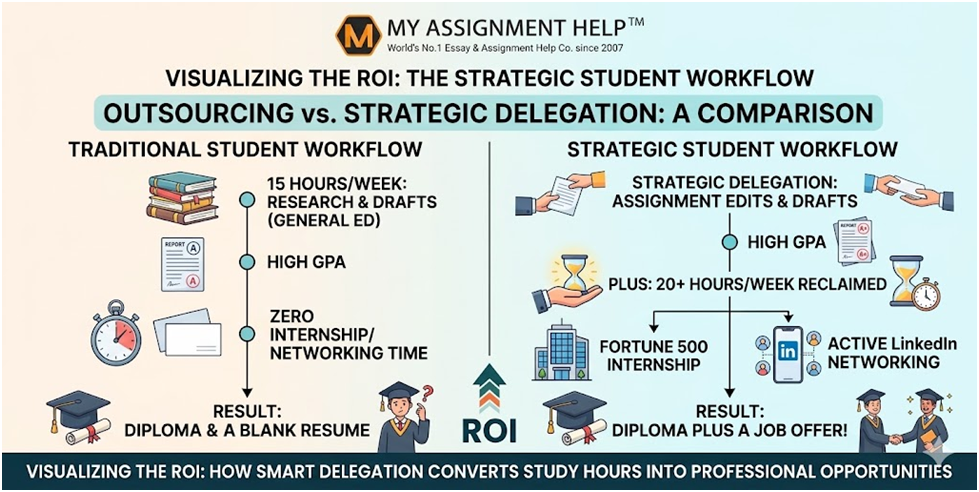
How Strategic Academic Support Accelerates Career Readiness
In the high-stakes, hyper-competitive environment of American higher education, the traditional “starving student” trope is being replaced by a new persona: the Academic Strategist. Today’s students are no longer just passive learners; they are project managers balancing punishing credit loads, vital internships, part-time jobs, and relentless networking.
The corporate concept of Return on Investment (ROI) is no longer confined to Wall Street. In the context of a four-year degree—often costing hundreds of thousands of dollars—ROI is measured by how effectively a student converts their limited time and tuition into professional marketability. This is where strategic outsourcing—once a corporate scalability secret—has become a vital tool for ambitious academics.
The Time Trap: Where US Students Lose Their Edge
According to 2024 data from the National Center for Education Statistics (NCES), full-time college students spend, on average, 15–20 hours a week on independent study and assignments outside the classroom. While necessary, not all of these hours yield the same professional return. Spending ten hours formatting a bibliography for a mandatory elective does not offer the same “career ROI” as spending ten hours analyzing case studies for a core major course.
The Shift from “Doing it All” to “Doing it Right”
The US Department of Labor recently highlighted that employers across all sectors are prioritizing “soft skills” like time management, prioritization, and strategic delegation over raw technical knowledge. When a student chooses to delegate a high-volume, lower-impact task, they aren’t avoiding work; they are prioritizing high-value activities.
For many high-achievers in the USA, balancing a 4.0 GPA with a competitive internship is a logistical nightmare. The most effective way to do my assignment for me is by ensuring that the meticulous research services performed at MyAssignmentHelp handle the heavy lifting, allowing students to reclaim their bandwidth for significant professional pursuits. By leveraging this professional support, learners can dedicate their primary mental energy to deep-work sessions for their major subjects or lead student organizations—activities that dramatically increase their post-graduation marketability.
Data-Driven Success: Outsourcing as an Educational Tool
Critics of academic support often overlook its primary function as an advanced learning aid. A 2024 survey on student productivity found that 65% of students with GPAs above 3.5 used external professional editing or tutoring services.
This is not about cutting corners; it’s about accessing specialized expertise that the standard university system often fails to provide:
- Skill Acquisition by Example: Professional academic writers provide a benchmark for excellence. Seeing a perfectly structured argument helps students understand the nuances of rhetorical rigor.
- The Power of Engagement: Consider the art of the opening hook. It is a critical, transferable skill for writing cover letters or professional reports. Learning by analyzing professional essay hook examples can instantly elevate a student’s own writing, teaching them how to “sell” an idea effectively.
- Mental Health as an Asset: The American Psychological Association (APA) consistently cites academic pressure as the primary driver of student burnout. Outsourcing general drafting tasks acts as a critical release valve, ensuring the mental clarity necessary for final exams and job interviews.
The Strategic Comparison: Finding the Right Support
For US students looking to optimize their academic ROI, it’s crucial to understand the different support models available. Not all support is created equal, and choosing the wrong one can waste time and money.
| Feature | Private Tutoring (e.g., University Center) | Traditional “Writing Service” | Strategic Academic Support (e.g., MyAssignmentHelp) |
| Primary Goal | Concepts & Understanding | Speed & Volume | Quality, Structure, & Skill-Building |
| Time Investment | High (requires live sessions) | Low (order-and-receive) | Low (collaborative and expert-driven) |
| Expertise Level | Often Peer-to-peer (other students) | Varies (often non-native) | Subject-Matter Experts (PhDs, Professors) |
| Cost (ROI) | Medium (low scalability) | Low (risk of low quality) | High (expert drafts serve as long-term study aids) |
| Best For | Reviewing difficult course concepts | Basic grammar checks | Complex papers, model drafts, and strategic editing |
A standard tutoring session is excellent for learning a concept, but it doesn’t give you hours back in your week. Basic writing services may save time, but often fail the E-E-A-T (Expertise, Authoritativeness, Trustworthiness) standards required by US universities. Professional, strategic support provides the high-level, credible output that students need to protect their GPA while regaining their time.
Key Takeaways
- Time is Your Currency: Treat your academic hours like a capital budget; invest them where they yield the highest professional dividend.
- Leverage is Mandatory: To compete in the modern US job market, you must learn the “soft skill” of strategic delegation.
- Learning is Modeling: Use professional drafts as a masterclass in structure, tone, and rhetorical strategy.
- Mental Clarity is Professionalism: Prioritize mental health; avoiding burnout is key to maintaining peak performance in both class and career prep.
FAQ Section
Q: Is using academic support services considered “cheating” in American universities?
When used responsibly—as a study aid, a source for model papers, or high-level editing—these are legitimate educational resources, identical to professional consultants in the business world.
Q: Does outsourcing assignments negatively impact learning?
On the contrary. By reviewing expert-level drafts, students often gain a better understanding of complex structures, proper referencing, and engaging writing (like analyzing professional essay hook examples) than they do from passive lecturing.
Q: How does this strategy directly improve career readiness?
It allows you to maintain the GPA needed to pass automated screening tools while reclaiming 15+ hours a week for high-value career activities like internships, networking, and skill certification.
Author Bio
Dr. Sarah Jenkins is a Senior Content Strategist and Academic Consultant at MyAssignmentHelp. With over 12 years of experience in the US higher education sector and a PhD in Educational Psychology from a top-tier US institution, Dr. Jenkins specializes in help students optimize their learning workflows, master complex communication, and achieve E-E-A-T compliant academic excellence.
References & Data Sources
- National Center for Education Statistics (NCES) – Annual Report on Student Time-Use and Academic Performance (2024).
- Bureau of Labor Statistics (BLS) – Report on Essential “Soft Skills” in the Modern Workforce (2025).
- American Psychological Association (APA) – “Stress in America: The Academic Pressure Cooker” (2024).
- Google Search Quality Evaluator Guidelines – Principles of E-E-A-T (Experience, Expertise, Authoritativeness, Trustworthiness) for educational content.